
Your Command Center for Cyber Investigation
Capture and preserve digital evidence, organize your investigations, and transform information into intelligence.
Designed for private investigation and cyber intelligence professionals and agencies, corporate security teams, and intelligence analysis, fraud, and risk specialists.
The extension requires a DossierAI account.
Join the DossierAI Private Beta
We invite private investigation, intelligence, and security practitioners and organizations to test DossierAI and share their experience to improve the platform.
Access during the beta is free and by invitation. We review each application; submitting an application does not guarantee admission.
System Architecture & Core Pillars
Intelligence methodology and preservation technology to support every investigation.
Orchestrated Intelligence Cycle
The platform core guides your team's workflow across the phases of the intelligence doctrine, ensuring methodological rigor.
Evidence Ingestion & Preservation
DossierAI preserves operational files and web captures by computing their SHA-256 hash without allowing edits from the platform, documenting ingestion with metadata and custody records under UTC standard.
Analysis & Report Generation
Analytical infrastructure to query dossiers via AI models, organize hypotheses in the ACH matrix, and map relationships. Includes an interactive editor to draft reports connecting sources and references [SRC-XX].
From your browser to your investigation dossier
Save a web page or select a screen region and send it to the dossier you choose. Keep the source context and continue its preservation, analysis and use in your report within DossierAI.
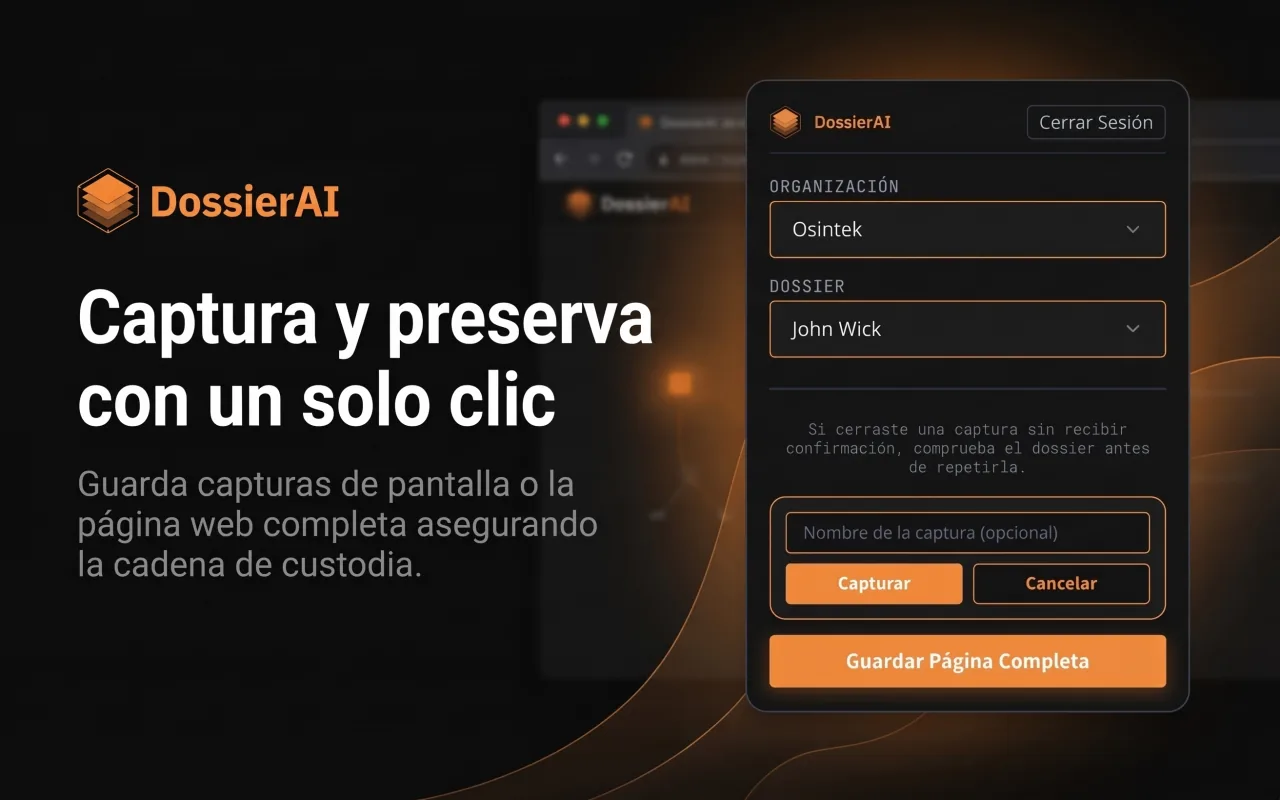
Capture screenshot
Enter an optional name, click Capture and select the page region you need. The PNG image is added to your chosen dossier.
Save full page
Save the active page as an MHTML archive. Its URL, title and UTC date accompany the source in your dossier.
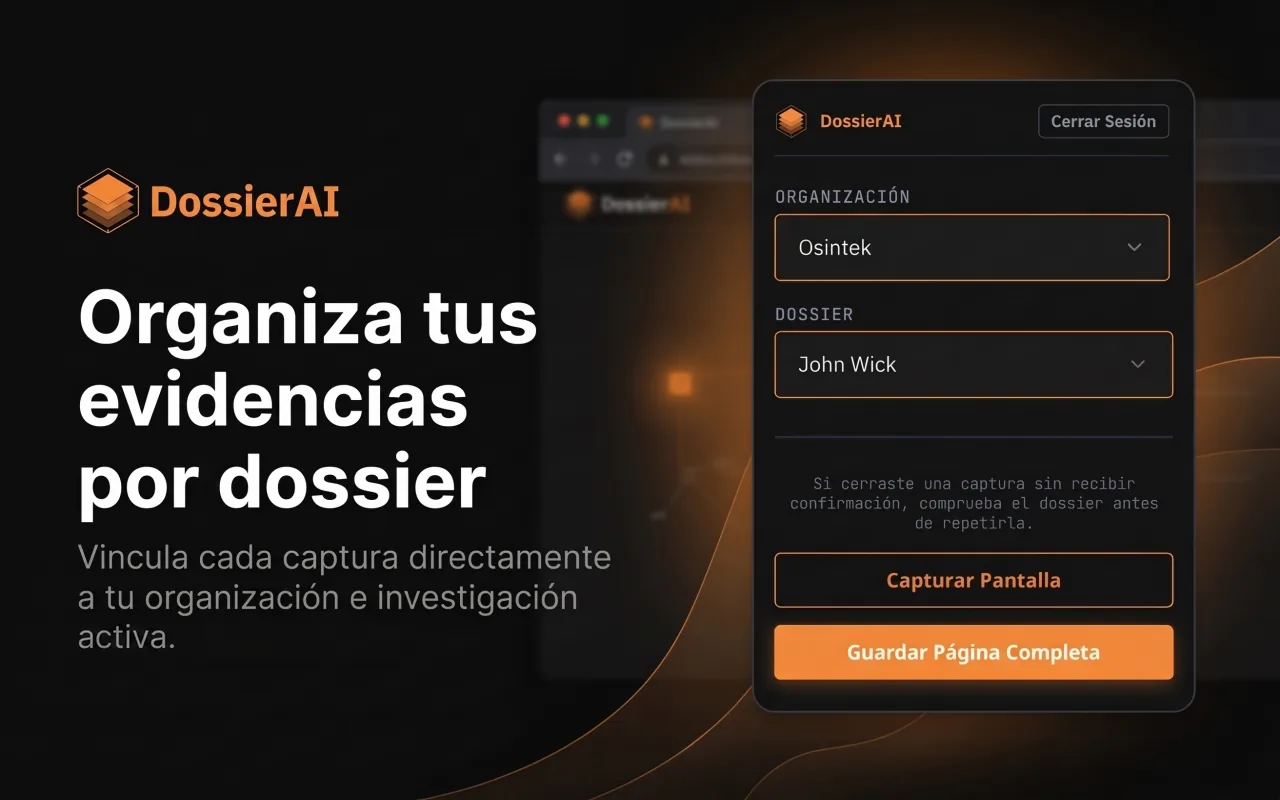
Directly to your dossier
Choose your organization and dossier before capturing. Both actions link the source to your investigation so you can continue preserving it, analyzing it and using it in your report.
Requires a DossierAI account, an active session and permission to add sources to the selected dossier.
Experience the interface in real-time
Interact with our DossierAI workspace simulator and explore the workflow of an investigation.
DOSSIER
DOSSIER:: Operation ShadowThread
OPERATIONAL AREA:: APT-41 Threats / C2 Infrastructure
Created: 03 Jun 2026
Updated: 09 Jun 2026
Hierarchical breakdown of intelligence requirements and operational tasks for the investigation.
Operational Intelligence Cycle
The four phases of the intelligence cycle integrated into a continuous workflow.
Direction & Planning
Define tactical objectives and intelligence requirements. Role-based access control (RBAC) and area and dossier assignments guarantee strict control and protect case compartmentalization.
Collection & Preservation
Consolidation and preservation of your sources. Centralize web captures via the native extension or add operational files (PDF, CSV, logs, video), instantly recording UTC date and time and a unique SHA-256 hash.
Processing & Analysis
An interactive canvas to connect your findings. Query AI models regarding dossier documentation, visually link case elements, and evaluate hypotheses.
Dissemination & Reporting
Secure generation and delivery of intelligence products. Draft executive reports in an interactive AI-assisted editor, incorporating sources and findings with direct indexed references [SRC-XX].
Zero-Trust Architecture
Zero-Trust architecture and role-based access control (RBAC). Membership in an organization does not grant automatic access to its investigations. DossierAI combines organization-level data separation with area and dossier permissions to restrict access to authorized information.
Infrastructure Isolation
Each organization has its own independent relational database and vector index. Files are stored in organization-exclusive paths within the platform's storage.
Role-Based Access Control — RBAC
DossierAI enforces role-based access control (RBAC), with permissions by organization, area, and dossier. Organization membership does not grant automatic access to its investigations, maintaining separation of duties and limiting access to necessary information.
Encryption & Digital Chain of Custody
DossierAI encrypts preserved files using AES-256-GCM and uses keys derived per organization. Activity logs allow reviewing the handling of evidence within the platform.
Frequently Asked Questions
How does DossierAI protect evidence integrity?
DossierAI preserves original files without allowing edits from within the platform and computes their SHA-256 digital fingerprint. This hash allows verifying that a downloaded file matches the preserved original exactly. Acquisition metadata and custody records document their ingestion and handling within the platform.
Can a user access investigations from other areas without authorization?
No. DossierAI enforces role-based access control (RBAC), with permissions by organization, area, and dossier. To access an investigation, the user must have the corresponding assignments and permissions. Organization membership does not grant automatic access to its investigations. This model enables collaboration across different areas when express authorization exists, maintaining separation of duties and limiting access to necessary information.
Where is investigation data stored and what deployment options exist?
Data is hosted in the European Union with independent databases per organization and logical storage separation. We plan deployment options and integration with organization infrastructure and AI models, including an on-premise option, subject to technical evaluation.
How does AI intervene in dossier analysis?
DossierAI uses open models running on cloud infrastructure from providers selected for their security and data protection guarantees to assist the investigator in entity correlation, hypothesis analysis, and report drafting. Authorized dossier content is used as context to answer investigator queries. The inference service used does not use this content to train models or improve its services without express authorization. Processing conditions are detailed in the privacy policy.
How does semantic search and content separation (Blind-RAG) work?
The vector index stores numerical representations and references, without embedding plaintext snippets into its metadata. Snippets are stored encrypted separately and retrieved for authorized processing.
Your Command Center for Cyber Investigation
Apply for beta access and experience how DossierAI streamlines digital evidence preservation, dossier organization, and AI-assisted reporting. During the beta, platform access is free and by invitation.